Monday, 17 November 2025

Monday, 18 November 2024

MD and TVP

 Because wells are not always drilled vertically, there may be two "depths" for every given point in a wellbore: the measured depth (MD) measured along the path of the borehole, and the true vertical depth (TVD), the vertical distance between the datum and the point of interest. In perfectly vertical wells, the TVD equals the MD; otherwise, the TVD is less than the MD measured from the same datum.

Simply put, MD is the total distance travelled by the drill bit from the surface of the well to a specific point along the borehole. It is essentially the length of the wellbore, measured along its path, regardless of any deviations or curves the borehole might take.

The Distinction between MD and True Vertical Depth (TVD)

MD is distinct from True Vertical Depth (TVD), which is the vertical distance between the surface and the specific point in the wellbore. TVD represents the actual depth below the surface, taking into account any deviations or curves in the wellbore.


MDHIP = MWHIP +TVP * DENSITY

Friday, 18 October 2024

Tuesday, 1 October 2024

 1) Std Ideal Liq Vol Flow (standard input on Aspen Hysys)

Volumetric flow is calculated based on ideal mixing of pure component ideal densities at 60 °F (15 °C).

2) Liq Vol Flow @Std Cond
Volumetric flow is calculated rigorously at the standard reference state for volumetric flow rates, and reflects non-ideal mixing effects.

3) Actual Volume Flow (not a direct input in Aspen Hysys)
Volumetric flow is calculated rigorously at the flowing conditions of the stream (i.e., at stream T and P).

Direct and reverse acting


GWR st std conditions


std conditions

 Std conditions are 101.325 kPaa and 60F


15.6 deg c and 101.325 Kpaaa


Brackish and fresh water


Wednesday, 18 September 2024

Cv and “Cf” of a valve

 Critical Flow Factor, often referred to as “Cf” is a coefficient that defines how pressure will recover after it drops to its lowest point inside the control valve. This lowest point is also referred to as the vena contracta*.

All globe-style control valves have a Cf that stays consistent regardless of the trim position, unlike the Flow Coefficient (Cv).

Note: The Pressure Recovery Factor (FL) also refers to the Critical Flow Factor in some literature.

What is Cf Used For?

Cf is a factor needed in order to calculate Flow Coefficient (Cv) or Flow Rate for valve sizing purposes. 


What is Valve Flow Coefficient (Cv)?

Valve Flow Coefficient (Cv) is a valve’s capacity for a liquid or gas to flow through it.

It is technically defined as “the volume of water at 60°F (in US gallons) that will flow through a valve per minute with a pressure drop of 1 psi across the valve.”

As the stem opens, the Cv increases.

The maximum Cv for the 2-inch regulator is 47, while the maximum for the 3-inch regulator is 117.


Tuesday, 17 September 2024

CWE

 Cold Water Equivalent means the barrels of steam expressed in terms of an equivalent cold water volume with the cold water density being 62.4 pounds mass per cubic foot.

999.5521145351039 kg/m3

Convert to mass flworate and then use that to determine the volumetric flowrate at the temp and pressure u desire

Bubbler Panel

Bubbler System Process

The bubbler system works by forcing a gas (compressed air) 

at a near-constant flow rate out the bottom of an open 

tube (bubble/dip tube) submerged in liquid. The back pressure 

in this tube is measured. With the process liquid’s density known, 

the level can be calculated using the back pressure and 

density. A pressure transmitter converts the back pressure to 

provide a 4-20ma output to a controller, which calculates 

the liquid’s level.

As the liquid level increases, the head pressure on the bubble tube gets higher. This means more pressure is needed to maintain a constant flow rate to overcome the pressure of the fluid.

If the fluid level goes down, so does the head pressure on the bubble tube and the pressure required to maintain constant flow rate of air or gas.  

To minimize maintenance requirements, we can add a purge line to clear the bubble tube of debris and buildup. This can be a manual operation with the push of a button, or automated with a purge schedule and timer.


https://www.instrumentationtoolbox.com/2014/06/bubbler-tube-system-for-level.html?m=0


https://automationforum.co/troubleshooting-advantages-disadvantages-and-application-of-the-bubbler-type-level-measurement-system/


Saturday, 14 September 2024

pump types

Types of pumps

https://www.ny-engineers.com/blog/main-types-of-pumps
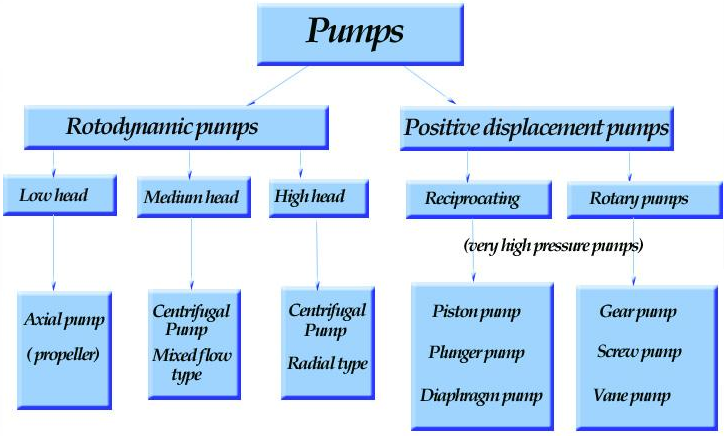
Fig.1. Pump classification.1


SUB-TYPE

DESCRIPTION

EXAMPLES

Reciprocating Pump

Flow is established inside a cavity that expands and contracts, such as a piston. Water moves into the cavity during expansion, and is forced out during contraction, while the flow direction is controlled by using check valves.

Bladder
Diaphragm
Peristaltic
Piston/plunger

Rotary Pump

This pump type uses a rotor that traps water in cavities, releasing it at the outlet. These cavities can be the spaces between gear teeth or screw threads, among other configurations.

Some designs use more than one shaft, but the principle is the same: the rotor shape is designed to capture “pockets” of water and displace them in the intended direction.

Gear
Screw
Progressing cavity
Rotary lobe
Rotary vane

SUB-TYPE

DESCRIPTION

PERFORMANCE

Axial Flow Pump

Also known as a propeller pump, it produces water flow along the impeller shaft direction.

High flow rate
Low pressure

Radial Flow Pump

This pump type produces flow in a direction perpendicular to the shaft (90° angle).

Low flow rate
High pressure

Mixed Flow Pump

This pump type combines radial and axial flow, producing a conical flow pattern around the shaft.

Medium flow rate
Medium pressure

Thursday, 13 April 2023

SOME LESSONS

 HEAT EXCHANEGR 


TUBE SIDE HOT FLUID


2 DIFFERNET CHECK VALVES WILL PREVENT FLOW CASE BUT NOT PRESSURE CASE


SPECTACLE BLIND WHEN NOZZLE NOT IN USE

Canned Pump

Canned motor pumps are preferred in the chemical and petrochemical industry, but also for simple pumping tasks, such as circulating pumps in industrial refrigeration equipment.

In general, the following media are conveyed: aggressive, toxic, explosive, hot, cryogenic, malodorous, volatile, flammable or carcinogenic substances – in brief, media that represent an environmental and health hazard.

Advantages of canned motor pumps at a glance:

  • Absolute leak tightness to the outside. Canned motor pumps meet the highest environmental protection standards.
  • Double containment shell to the atmosphere. The motor housing and terminal box are designed as pressure-containing parts and as a second containment shell.
  • Extremely low sound level
  • ZART® technology ensures non-contact, wear-free operation of the rotor unit
  • Practically no wear and minimal maintenance
  • High availability and long service life
  • Reduced maintenance and low life cycle costs
  • Higher MTBF values compared to conventional chemical pumps with mechanical seal
  • Easy installation, no alignment of motor and coupling required


·         Canned motors are employed wherever hot, aggressive, explosive, toxic or radioactive fluids need to be pumped, which is why a great deal of focus is placed on hermetically sealed pump sets without gland packings or mechanical seals. Canned motors are used for circulators reactor circulating pumps (see Reactor pump), and process pumps for chemical and process engineering applications.
See Fig. 1 Canned motor

·         Fig. 1 Canned motor pump: Single-stage volute casing pump for general industrial applications

·         Fig. 1 Canned motor pump: Single-stage volute casing pump for general industrial applications


Steam flooding

Stam inject and sweep oil to well

Canned – sump pump, not enough npsh, in our plant for solvent (500-600 kg/m³)

Impeller under the ground, impeller of the pump is underground to provide head for pump and suction

Solvent booster pumps are canned and solvent feed pump are canned type


0012 I scanned pump to be used


Lean or rich gluycool can be water content , can be solvent or water or gas content in gas or h2s or co2

Production crossover


ALL HEAT XCHNAGERSS ARE CONSIDERED AS A PRESSURE VESSEL SO THEY HAVE A PSV AS PER THE ASME CODE ON BOTH SIDES


ALL VESSELS COZ OF THE ACCUMULATION PRESSURE WILL HAVE PRESSURE CLASS CHANGE AT THE BOTTOM AND ITS BEST TO HAVE IT AT THE NOZZLE SINCE THE NOZZLE WILL HAVE A PRESSURE CLASS CHANGE ANYWAYS


Thursday, 5 July 2018

Pressure drop and velocity criteria:

Pressure drop and velocity criteria:
Pressure drop high- it will not meet the delivery pressure, pump/compressor  motor size will increase as well
Pressure drop Low -

Velocity high -  straightened out the bends in the pipe, lead to water hammering issues or instability inline 
Velocity low - lead to deposition of particles in the pipe

Sunday, 10 April 2016

Removing hydrates for gas

The formation of hydrates in natural gas processing facilities and pipelines is a critical issue as hydrates can plug equipment, instruments, and restrict or interrupt flow in pipelines. Generally, hydrates will form when the temperature is below the hydrate formation temperature, normally with “free” water present, depending on the gas composition and pressure. 
In general, hydrates can be prevented by:-
1. Maintaining the system temperature above the hydrate formation temperature by using a heater and/or insulation or compression the gas.
2. Dehydration of the gas to prevent the condensation of a free water phase.
3. Injection of thermodynamic inhibitors to suppress the hydrate formation temperature in the free water phase. Methanol (MeOH) is widely used as an inhibitor in natural gas pipelines, particularly in cold climate facilities (e.g., Canadian environments). In these difficult environments, methanol injection is the most economical solution for preventing hydrate formation and is often the only option.The challenge
The determination of methanol injection rate can be a very challenging task for engineers -mainly because of methanol partitioning: the injected MeOH may partition into three phases: (a) the aqueous phase, (b) the vapor phase and (c) the hydrocarbon phase. \


Criteria:

GPSA: Folow the chapter

Aspen Hysys:

Do not use the Peng Robinson package 
This month (May 2015), Aspentech released HYSYS v8.8 with the addition of the Cubic-Plus-Association (CPA) fluid property package. The new CPA PP can more accurately model methanol phase behaviors, especially in the modelling of liquid-liquid equilibria (LLE) including the prediction of the partitioning of methanol between water and hydrocarbons in the hydrocarbon phase.

Albert'a climate change policy

The new policy is intended to urge consumers and companies to use lower-carbon, cleaner, and renewable energy resources instead of high-priced and high-emissions energy. The implementation of the policy will speed up the reduction trend in carbon emissions in the short term and in the longer term, it will create an environment encouraging innovative ideas and new technologies and make an opportunity for lower-carbon products to compete in the energy market 

At an initial price of $20 per tonne in 2017, rising to $30 in 2018, and rising at inflation plus 2 per cent after that, this is a tangible price on carbon that is within the range of reasonable estimates of the true cost of carbon. The new carbon taxation is evaluated to generate revenue of around $3 billion by 2018, and potentially increasing to over $5 billion by 2030 [1] 

Firms will pay a carbon tax of $30 per tonne, just like everyone else.
Facilities emitting 100,000 tonnes CO2E/yr or more from all sources are required to reduce their emissions per unit of production by 15% below their historical baseline emissions intensity in 2016 and to 20% in 2017. 
If a facility reduces its emissions intensity below its emissions target, it may generate “Emissions Performance Credits” (EPCs) [2] which can be banked and accumulated for future years or be traded in the carbon market. On the other hand, facilities with annual emissions intensity over the limit which are not able to improve their performance to meet their targets must acquire credits. They may either use their banked EPCs from previous years, or purchase EPCs from a different facility, or “Emissions Offset Credits”, or pay their carbon tax to the Climate Change and Emissions Management Fund.


Facilities that emit 100,000 tonnes of CO2 Annually


Under the existing SGER :
  • Any facility that emits more than 100,000 tonnes of carbon dioxide (CO2) per year is considered a “regulated facility” and is required to reduce its emissions intensity by 12 per cent versus its operational baseline.
  • Contribute to the Fund and purchase a Fund credit, the cost of which has remained at C$15/tonne of CO2 since July 1, 2007
After the Alberta's Climate Change policy

  • Increasing the operational efficiency requirements from 12 per cent to 15 per cent to 20 per cent over two years will have a dramatic impact on existing facility operation.
  • Increasing the costs of Fund credits from C$15/tonne to C$20/tonne to C$30/tonne will have a direct impact on a regulated facility’s compliance costs.


Wednesday, 6 April 2016

Aspen Hysys tricks

Finding if u fall in the supercritical region in Aspen Hysys

1) it will itself say that "A temperature stream is not found at requested condition" 
2) Press cntl + U to see the critical pressure and temperature
2) Look at the envelope curve

BUUBLE POINT / BOILING POINT / VP

setting vapour fraction = 0 or 0.00000001 gives u the vapour pressure at that temperature
It also gives u the bubble point since first bubble or boiling point  is formed at that point

DEW POINT

Alternatively setting vf = 0.99999999 or vf = 1 sets dews point 

VP and OP  VP > OP = Flashing 
VP = OP  = boiling 
VP < OP = Trying to boil

vapour pressure greater than operating pressure (for a multicomponent mixtures) just means that the liquid is flashing (Vapor-liquid mixture).


VP and Tmp. and Molecular weight
VP decreases with molecular weight and increases with temperature

PV  = NRT 
PV X Molecular Mass = mass RT 

Also for a a biggher moecular harder to break the bonds


  • Hydrocarbon dewpoint calculations are very sensitive to trace amounts of heavier hydrocarbons. 
  • The hydrocarbon dewpoint for an analysis which shows an amount of "C7+" can have a very different dewpoint depending on whether the heaviest component is assumed to be (e.g.) n-C7 or n-C10.
  • One should be aware of the maximum pressure for the phase envelope (cricondenbar). In the supercritical (dense phase) region, the concept of a dewpoint is not applicable. However, it should be noted that HYSYS may apply a vapour fraction of 0 or 1 in the supercritical region as an indication of which correlations are being used for the stream.

H20 demand in oil and gas industry

 Water demand is extensive in non conventional oil and gas extraction namely, SAGD, mining, and  hydraulic fracturing.

Water and energy demand are interlinked. Increasing the efficiency of one effects the other.


Produced water treatment operations, required to protect the environment and recycle more water, increase the cost and the energy requirements to extract these resources.
Evaporator, WLS, and ZLD technologie sin SAGD.

Directive - 081 state that SAGD CPF technology need ts to recycle

3 % - fresh water
30%  - brackish water
10% - produced water

Overcoming solution is reusing municipal wastewater by industry have started to become interesting for some facilities.

Water sourcing selection criteria include environmental impact, stakeholder relations, availability, timing, quality and economics. 

A particular technical challenge that may limit the use of some water sources is that of "compatibility" with reservoir characteristics- scaling could become a major problem if ignored. 

Tuesday, 5 April 2016

Aspen Hysys and Aspen Plus and Pro

ASPEN PLUS

  • ·      Aspen Plus Has Solids Handling Capabilities In It.
  • ·      It Has An "Automatic Recycle" Capability Whereas In HYSYS You Have To Add Them Manually.
  • ·      Better User Interface
  • ·      Good For Polymers
  • ·      Aspen Plus Evolved As A Chemical Process Simulator - It Is Very Strong For Simulating Non-Ideal Properties, Systems With Electrolytes, Solids, Azeotropes, And Chemical Reactions. It Is Also Strong For Modeling Large-Scale Flowsheets (Using The Equation-Oriented Approach).
  • ·      Aspen Plus Thermodynamic Library Is Considered To Be Quite Extensive And Hence Considered Quite Useful In Simulation Of Fine Chemicals And Pharmaceutical Chemicals
  • ·      Aspen Plus Is Better Suited For Chemical Process Design Whilst HYSYS Is Best For Hydrocarbon Process Design (Both Upstream And Downstream But Mainly Downstream). 
  • ·      Very Absurd And Obsolete Dynamic Module.


PRO II

  • ·      Bad Support
  • ·      Much More Friendly - Easy To Set Up
  • ·      Runs Many More Iteration With Just One Click As Compared To Hyssops
  • ·      We Can Model Solids Inside It 
  • ·      We Can Develop An Entire Spreadsheet On The Flowsheet To Perform Sensitivity Analysis And See The Result At Once
  • ·      However We Have To Create A Spreadsheet For It For Specific Label On The Flowsheet
  • ·      We Can Ignore A Specific Section Of  Flowsheet And Conserve The Rest And Then Converge The Remaining
  • ·      Suplur Removal Unit Can Set Up A Unit Operator With Specifications At The Outlet
  • ·      Crashes a lot more


HYSYS
  • ·      Hard To Set Up
  • ·      Good Support
  • ·      Hysys Cannot Model Sulfur Recovery Units, Either. However, Hysys May Be Able To Do Some Processes Outside Of Oil & Gas, I Don't Know, Never Tried.
  • ·      Hysys Cannot Model Any Sour Process Or Wet Process Very Well.
  •  


PROMAX
  • ·      Amine Sweetening, Dehydration And Sulfur Recovery Makes Promax The Best
